Coping Skills For Trauma are structured behavioral, cognitive, and somatic strategies that help trauma survivors regulate their nervous system, process distressing memories, and restore a sense of safety in daily life.
According to the World Health Organization, approximately 70% of people worldwide experience at least one potentially traumatic event in their lifetime, and roughly 5.6% go on to develop PTSD — equating to nearly 9 million Americans living with the condition at any given time (NIMH). Without active coping strategies, untreated trauma disrupts relationships, work function, physical health, and long-term psychological well-being.
Key Takeaways:
- Trauma coping skills span three core domains: cognitive (thought-based), somatic (body-based), and behavioral (action-based) strategies.
- Grounding techniques interrupt flashbacks and hyperarousal by anchoring survivors to the present moment.
- CBT and EMDR are the most clinically validated trauma treatments, endorsed as first-line options by the American Psychological Association and the World Health Organization.
- Social support is a structural protective factor — trauma survivors with strong networks show significantly lower rates of chronic PTSD.
- Women are nearly twice as likely as men to develop PTSD, with lifetime prevalence of 10–12% vs. 5–6% (American Psychological Association, 2024).
- Physical activity and breathwork directly regulate the autonomic nervous system dysregulation caused by trauma.
- Early professional intervention after trauma significantly reduces PTSD progression and associated comorbidities, including substance use disorder.
1. Grounding Techniques
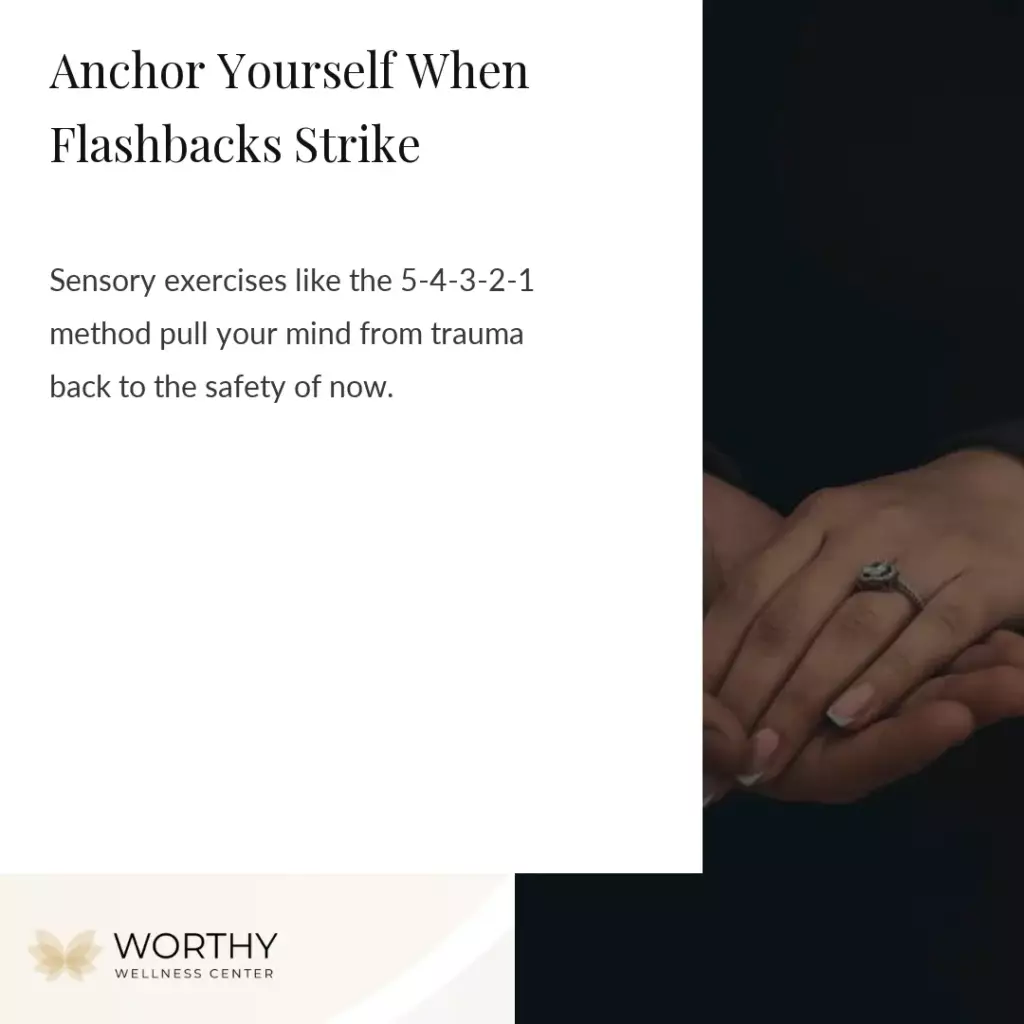
Grounding techniques are sensory and cognitive exercises that redirect attention from traumatic memories or flashbacks to the present environment. The nervous system interprets trauma triggers as immediate threats; grounding interrupts this response by engaging the prefrontal cortex rather than the threat-reactive amygdala.
The 5-4-3-2-1 technique — naming five things you see, four you can touch, three you hear, two you smell, and one you taste — is one of the most widely taught grounding methods in trauma-focused CBT and DBT programs.
Temperature-based grounding, such as holding cold water, also activates the mammalian dive reflex, which slows heart rate and dampens the sympathetic stress response. Consistent grounding practice trains the brain to interrupt hyperarousal cycles before they escalate to full dissociation or panic.
2. Mindfulness and Controlled Breathing

Mindfulness is the practice of sustained, non-judgmental attention to present-moment experience — thoughts, sensations, and emotions — without reactive avoidance. For trauma survivors, mindfulness disrupts the cycle of rumination and hypervigilance that perpetuates PTSD symptom clusters.
Diaphragmatic breathing at a slow, belly-directed rhythm activates the parasympathetic branch of the autonomic nervous system, directly counteracting the fight-or-flight state that trauma triggers. The VA’s National Center for PTSD recommends controlled breathing as a front-line, immediately accessible skill for managing acute traumatic stress reactions.
Mindfulness-based stress reduction (MBSR) programs have demonstrated measurable reductions in PTSD symptom severity, including lower cortisol levels, improved sleep, and reduced emotional reactivity.
3. Cognitive Reframing

Cognitive reframing is the process of identifying and challenging distorted, trauma-reinforced thought patterns and replacing them with more accurate, adaptive interpretations. Trauma systematically distorts core beliefs about safety, self-worth, and trust — and these distortions maintain PTSD long after the triggering event has passed.
Research from PMC shows that cognitive reappraisal increases resilience, positive affect, and behavioral control in trauma survivors. In clinical settings, cognitive processing therapy (CPT) uses structured reframing to directly address the “stuck points” — maladaptive beliefs — that sustain trauma symptoms.
A survivor holding the belief “I am permanently broken” can, through guided reframing, arrive at “I was harmed and I am healing” — a neurologically distinct cognitive state that reduces avoidance and self-blame.
4. Social Support Networks

Social support functions as a structural buffer against the neurobiological effects of trauma, reducing isolation-driven threat perception and increasing access to coping resources. Longitudinal research on trauma and coping identifies social support-seeking as one of three primary adaptive coping styles, alongside approach coping and problem-focused coping.
Trusted relationships with family, friends, peers in recovery, or support groups provide both emotional co-regulation and practical assistance — both independently protective against PTSD chronification. SAMHSA’s trauma-informed care framework identifies peer support workers — individuals with lived trauma experience — as particularly effective in building therapeutic alliances with survivors who distrust institutional settings. Investing in and maintaining a support network is not passive; it is an active, protective decision that reduces the neurological burden of carrying trauma responses alone.
5. Physical Activity and Somatic Awareness
Physical activity directly addresses the body-stored dimension of trauma — the muscle tension, startle responses, and chronic physiological arousal that cognitive-only interventions cannot fully resolve. Exercise increases brain-derived neurotrophic factor (BDNF), which supports hippocampal neurogenesis and counteracts the hippocampal volume reduction associated with chronic PTSD.
Somatic approaches — including yoga, somatic experiencing therapy, and body scan practices — teach survivors to track and release trauma held in the physical body without requiring verbal narrative of the traumatic event.
Aerobic exercise at moderate intensity (30 minutes, 3–5 times per week) has been shown in clinical trials to reduce PTSD severity scores comparably to some pharmacological interventions. The body is not a passive recipient of trauma; it is also a primary site of recovery.
6. Expressive Writing and Journaling
Expressive writing is the structured practice of translating traumatic experiences, associated emotions, and survival responses into written narrative form. Dr. James Pennebaker’s foundational research established that writing about traumatic events for 15–20 minutes over three to four consecutive days produces measurable reductions in psychological distress, physician visits, and immune biomarkers.
Journaling separates trauma from identity — externalizing the narrative on paper reduces its cognitive load and creates enough distance for the prefrontal cortex to process what the limbic system could not during the original event. Trauma journaling is purposeful and time-bounded, guided by prompts designed to move from description toward meaning-making rather than repetitive rumination. For survivors who find verbal therapy difficult, journaling provides a lower-threshold, self-directed entry point into trauma processing.
7. Trauma-Focused Professional Therapy (CBT and EMDR)
Trauma-focused professional therapy represents the highest-evidence tier of trauma coping, with Trauma-Focused CBT (TF-CBT) and Eye Movement Desensitization and Reprocessing (EMDR) endorsed as first-line treatments by both the World Health Organization and the American Psychological Association.
TF-CBT combines psychoeducation, cognitive reframing, exposure exercises, and skill-building in a structured protocol that directly targets the avoidance and re-experiencing symptom clusters of PTSD. EMDR uses bilateral sensory stimulation — eye movements, tapping, or tones — to facilitate the brain’s adaptive information processing of traumatic memories, reducing their emotional charge without requiring detailed verbal recounting.
According to WHO, up to 40% of people with PTSD recover within one year when receiving evidence-based treatment. Early clinical intervention administered following acute trauma substantially attenuates long-term PTSD risk, as documented in longitudinal resilience research published in PMC.
8. Establishing Routine and Structure
Consistent daily routine is a structural coping skill that restores the sense of predictability and control that trauma disrupts at a neurological level. Trauma dysregulates the hypothalamic-pituitary-adrenal (HPA) axis, producing erratic cortisol patterns that destabilize sleep, appetite, attention, and mood — and anchored daily rhythms recalibrate this axis over time.
Routine components with the strongest evidence base include consistent sleep and wake times, regular mealtimes, scheduled physical activity, and planned social contact, all of which signal safety to the threat-detection system.
The VA’s National Center for PTSD includes routine maintenance as a core active coping behavior alongside direct trauma symptom management techniques. Structure does not eliminate triggers, but it reduces the baseline allostatic load on the nervous system, making symptoms less frequent and less severe when they do arise.
Summary
Coping skills for trauma work across cognitive, somatic, behavioral, and relational domains to regulate the nervous system, process traumatic memory, and rebuild safety — and the most durable recovery combines multiple strategies, with professional therapy providing the structured clinical framework that self-directed skills alone cannot replicate.
Building effective coping skills for trauma is a process that benefits from expert clinical guidance — particularly when trauma intersects with co-occurring mental health conditions. Worthy Wellness Center, based in Carlsbad, CA, offers trauma-informed treatment programs for women, integrating evidence-based modalities including EMDR therapy, somatic experiencing, and individualized cognitive behavioral approaches. If you or someone you care about is navigating the effects of trauma, Worthy Wellness Center can help create a personalized path toward lasting recovery.